Japan and Korea’s Technology Headlines: Why Custom PCBA Development Matters for Appliance Brands
October 21, 2026 | CHK-TRONIC Engineering Insights
Technology-related exports are in the spotlight in Japan and South Korea today. Reuters reports that semiconductor and AI-related demand supported Japan’s September export growth. In South Korea, Yonhap reports strong semiconductor shipments behind a sharp increase in exports during the first 20 days of October.
These developments highlight activity across the electronics industry. They do not, by themselves, establish rising demand for hair dryer control boards. For appliance brands, however, they provide a useful starting point for a more practical question: how can electronic components become a differentiated, dependable product?
CHK-TRONIC’s answer begins with development—connecting control-board hardware, embedded firmware and the requirements of the finished appliance.
From a product idea to a control-board specification
A new appliance project often starts with a commercial goal: a more compact hair dryer, a different temperature interface, or a styling tool with customized operating modes.
Turning that goal into a working product requires an engineering specification. The input voltage, rated power, motor characteristics, heating system, board dimensions and user interface must work together.
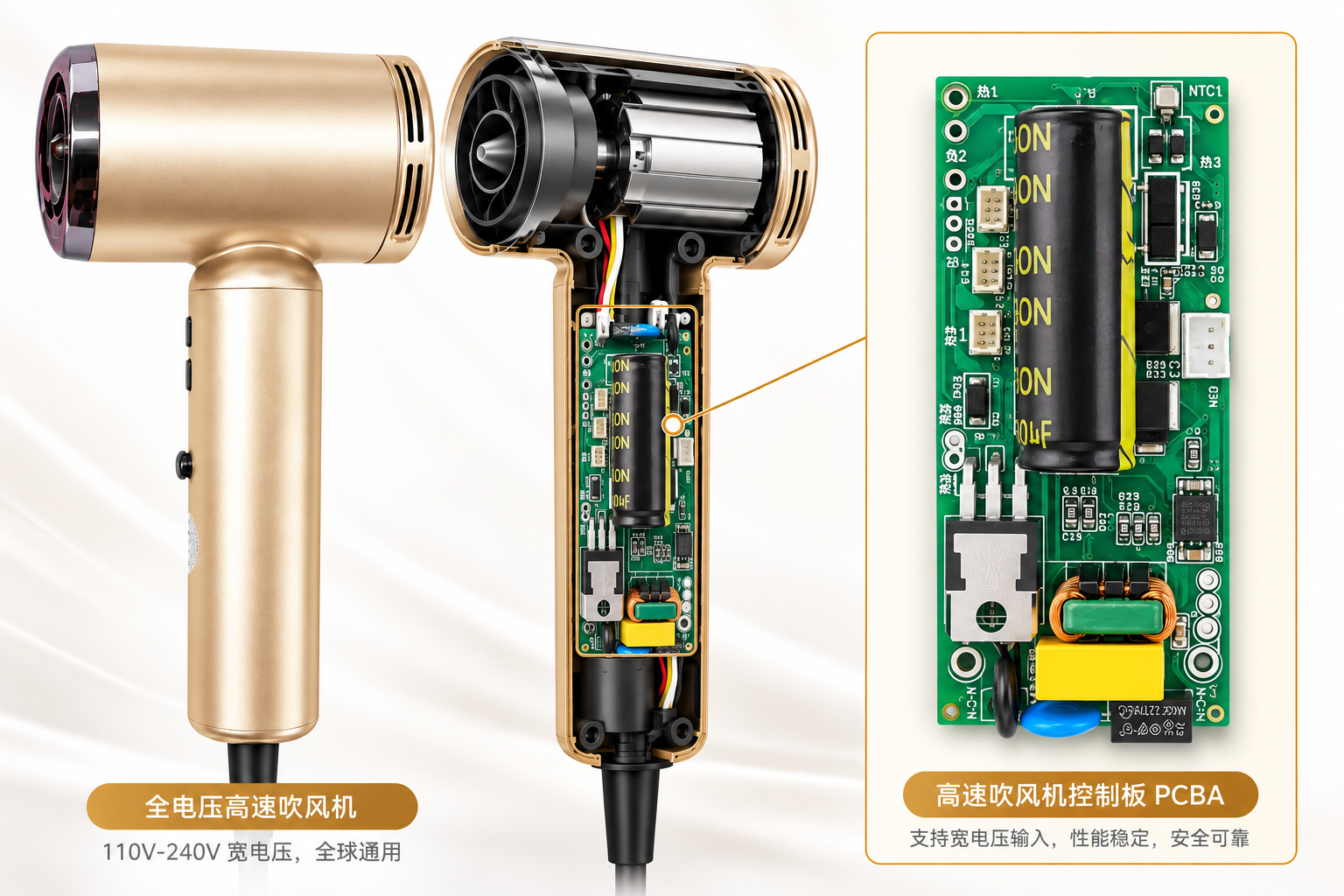
CHK-TRONIC’s consumer appliance PCBA development focuses on this connection between product requirements and electronic implementation. For customers developing hair dryers, straighteners and curling irons, the discussion can start with functional requirements and samples—even before a finished circuit design is available.
The first development milestone is a clear definition of what the control system must do, how it fits inside the product and how its performance will be evaluated.
BLDC motor control development for hair dryers
For a high-speed hair dryer, a target motor speed is only one part of the design brief. The controller must be evaluated with the intended motor and the complete appliance configuration.
Relevant development questions include startup behavior, speed selection, motor-driver compatibility, coordination with heating modes and responses to abnormal operating conditions.
CHK-TRONIC’s BLDC motor control development offering is relevant to brands developing a new hair dryer platform or adapting an existing product.
Providing a motor sample, electrical specifications and the available PCB space helps establish a practical basis for evaluation. Changing the motor or power requirements should trigger an engineering review rather than an assumption that an existing board will remain suitable.
Embedded firmware turns specifications into user experience
Firmware determines how an appliance responds to its buttons, sensors and operating states. It is also an important area for customization.
Depending on the approved hardware, development may address:
- Speed and temperature mode combinations.
- Default startup settings.
- Button actions and operating sequences.
- LED indications and status feedback.
- Temperature-control behavior and fault responses.
For a hair dryer, these decisions shape how users switch between airflow and heating modes. For straighteners and curling irons, they shape temperature selection, operating feedback and shutdown behavior.
CHK-TRONIC’s embedded firmware development services connect these functional requirements with the control electronics. Defining the behavior early helps customers review a product’s operation before committing to volume production.
Hardware customization must account for the complete appliance
A control board has to fit both the electrical requirements and the physical product.
PCB dimensions, component placement, connectors, button-board interfaces and sensor connections all need to be considered alongside the motor, heater and enclosure.
This makes hardware development particularly valuable when a customer wants to:
- Fit a control system into a new housing.
- Adapt an existing platform to a different motor.
- Develop a separate main board and user-interface board.
- Change power requirements or operating functions.
- Prepare different product versions for target markets.
The development scope should identify which changes can be implemented in firmware and which require new hardware, samples and validation. This distinction makes quotations and project schedules easier to assess.
Development continues through prototype evaluation and manufacturing
A working prototype is an important milestone. Preparing it for repeatable production requires the approved hardware, component list and firmware version to remain aligned.
A practical project sequence is:
Requirements review → hardware and firmware development → prototype evaluation → agreed revisions → pilot production → volume manufacturing.
For each stage, the customer and supplier should agree on the expected deliverables and acceptance criteria. The manufacturing plan should also address programming, inspection, functional testing and engineering change control.
CHK-TRONIC connects development with PCBA engineering and manufacturing, helping customers discuss both the control solution and its production requirements within the same project.
What today’s headlines mean for your next product
Japan and Korea’s export news reflects broader electronics activity. Our engineering takeaway is more specific: appliance differentiation depends on how effectively hardware and software are developed around a clear product requirement.
A successful control solution must deliver the intended behavior within the product’s electrical, mechanical and commercial constraints. That is where custom PCBA development becomes valuable—from selecting a suitable control architecture to refining firmware and preparing an approved design for manufacturing.
Start a development discussion with CHK-TRONIC
Planning a high-speed hair dryer, straightener, curling iron or another consumer appliance?
Send your product type, target market, input voltage, rated power, motor or heater specifications, available board dimensions and required functions to jack@chkcorp.cn.
Visit www.abcpcba.com to explore CHK-TRONIC’s development and manufacturing services.
News references
- Reuters — Japan’s September exports rise on chip demand, October 21, 2026
- Yonhap — Exports double in first 20 days of October on robust chip shipments, October 21, 2026
The connection between these news developments and appliance engineering is CHK-TRONIC’s editorial analysis.