Canton Fair 2026: A PCBA Sourcing Guide for Small Appliance Buyers
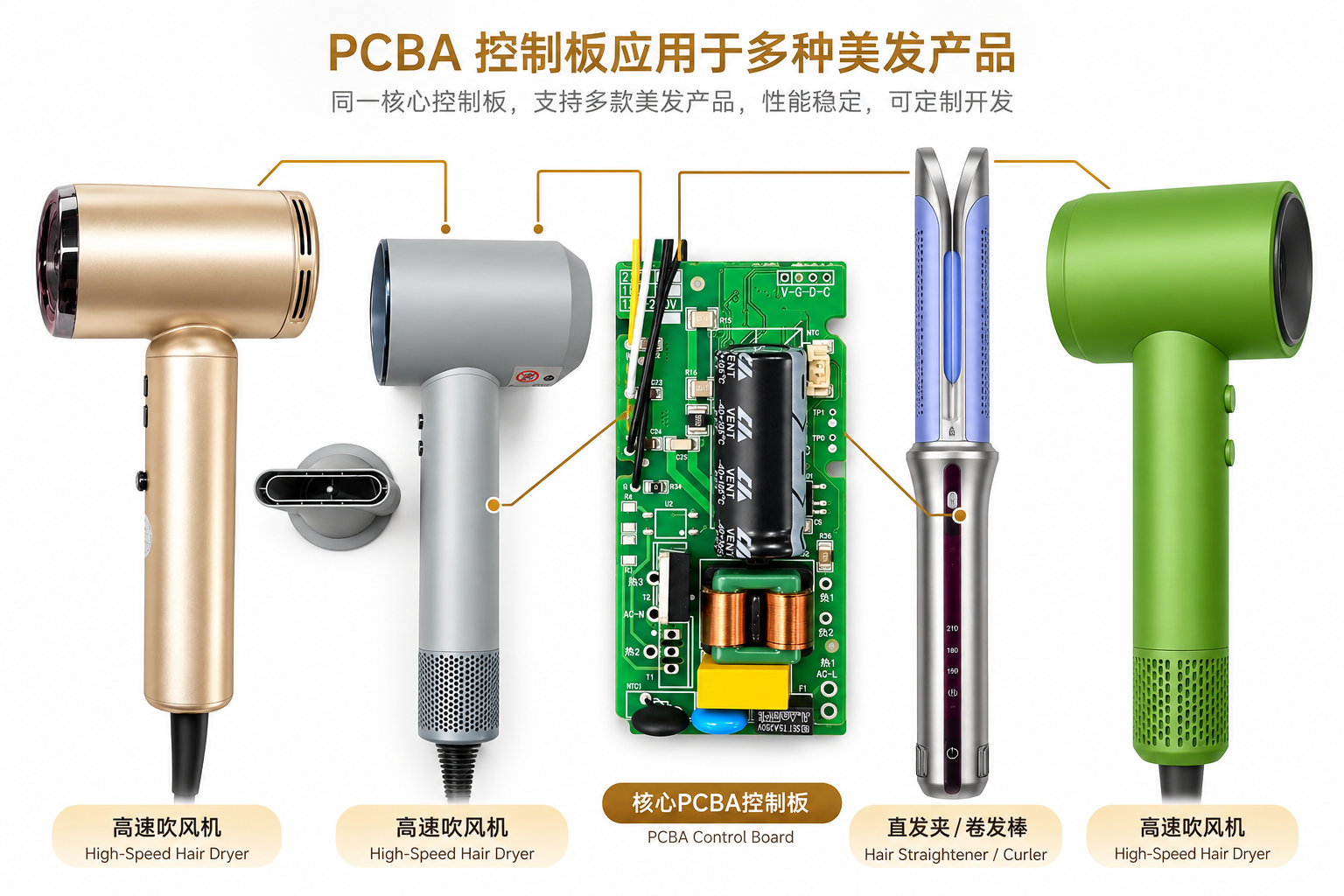
The first phase of the 140th Canton Fair takes place from October 15 to 19, 2026, bringing electronics and appliance sourcing into focus. For buyers evaluating small appliances, a successful sourcing decision involves more than product appearance, packaging and an attractive sample price.
Inside every electronically controlled appliance, the printed circuit board assembly—or PCBA—helps determine how the product operates. For high-speed hair dryers, straighteners and curling irons, the control system deserves close attention before a purchase order moves into production.
At CHK-TRONIC, our focus is on consumer appliance control solutions, connecting electronic hardware development, embedded firmware and PCBA manufacturing. Here are the questions we recommend buyers bring into their sourcing discussions.
Start with the product requirements behind the sample
A demonstration sample shows what a product can do under specific conditions. A production specification defines what every delivered unit must do.
Before requesting a control board quotation, clarify the target market, input voltage, rated power, operating modes, installation space and expected order quantity. For a hair dryer, include the motor specifications and heating requirements. For a straightener or curling iron, define temperature settings, warm-up expectations and user controls.
These details help engineering teams evaluate the project and reduce revisions caused by incomplete requirements.
High-speed hair dryers need a matched control system
When evaluating a high-speed hair dryer project, buyers should discuss the motor, driver electronics, heating control and firmware as one system.
A useful engineering review should address:
- Compatibility between the BLDC motor and its control board.
- Startup behavior and speed settings.
- Coordination between airflow and heating modes.
- Temperature sensing and responses to abnormal conditions.
- PCB dimensions, connectors and assembly constraints.
A board that works with one motor should not automatically be assumed suitable for another. Motor samples and technical specifications provide a stronger starting point for development than a target RPM alone.
CHK-TRONIC’s BLDC motor control development services are relevant to buyers developing new hair care products or reviewing an existing control platform.
Firmware creates meaningful product differentiation
Two appliances with similar housings can offer different user experiences through their control logic.
Depending on the hardware design, firmware customization can cover speed and temperature combinations, default startup settings, button behavior, LED indications and operating sequences. Straighteners and curling irons may also require different temperature profiles and automatic shutdown behavior.
Buyers should define these functions before approving samples. A written function specification gives the buyer, developer and production team a common reference.
Learn more about CHK-TRONIC’s embedded firmware development.
Ask how the approved sample becomes a repeatable production process
SMT assembly is an essential part of PCBA production. A sourcing discussion should also cover how the approved hardware and firmware versions are maintained across production batches.
Ask potential suppliers how they manage:
- BOM approval and component substitutions.
- PCB and firmware revision control.
- Assembly inspection and functional testing.
- Programming records and product identification.
- Pilot-run feedback before volume production.
These questions help reveal whether a quotation covers only board assembly or includes the engineering and production controls needed for the project.
CHK-TRONIC combines control-board development with manufacturing support. Explore our PCBA engineering and manufacturing capabilities when planning the transition from prototype to production.
Define market requirements before changing voltage or power
A product intended for a 110–120V market may require different hardware and validation from a 220–240V version. Buyers should confirm the electrical configuration early rather than treat voltage changes as a final packaging decision.
The same approach applies to product safety and electromagnetic compatibility. Agree on the target market, applicable requirements, testing responsibilities and documentation before final approval. Control-board development is one part of the process; the finished appliance must be evaluated in its complete configuration.
Turn Canton Fair discussions into an actionable RFQ
After comparing suppliers and collecting samples, prepare a short technical brief for the next stage. Include:
- Product type and target market.
- Input voltage, frequency and rated power.
- Motor specifications or a motor sample, where applicable.
- Required operating modes and user interface.
- Board dimensions and available installation space.
- Prototype quantity, expected production volume and launch schedule.
- Available drawings, specifications or existing samples.
This makes it easier to compare engineering proposals, understand development scope and identify missing information before committing to tooling or production.
Discuss your next small appliance control board with CHK-TRONIC
For brands, OEM manufacturers and assembly partners developing high-speed hair dryers, straighteners or curling irons, CHK-TRONIC can discuss control-board design, firmware customization and PCBA production requirements.
Send your motor specifications, input voltage, rated power and functional requirements to jack@chkcorp.cn, or visit www.abcpcba.com to start a project discussion.
Event reference: China Import and Export Fair — Official Website
This article is CHK-TRONIC’s engineering and sourcing commentary for appliance buyers. It does not imply participation in or endorsement by the Canton Fair.