Hair Care PCBA Sourcing in Mexico and Türkiye: Managing Cost and Production Consistency
October 5, 2026 | CHK-TRONIC
For hair care appliance brands in Mexico and Türkiye, choosing a control board means balancing product performance, development cost and manufacturing requirements.
Recent developments in both markets offer useful context. In Mexico, manufacturers are discussing stronger local supply chains. In Türkiye, the latest inflation figures highlight the importance of clear cost planning.
For companies developing hair dryers, straighteners and curling irons, these developments raise a practical question: how can buyers select a PCBA solution that meets their product requirements and supports consistent production?
Mexico: Stronger Local Supply Chains Need Clear Engineering Interfaces
On October 5, El Informador reported that Salvador Maese Barraza, president of Index Mexicali, called for greater domestic supplier participation and stronger regional manufacturing supply chains.
This is an industry perspective, rather than a new mandatory sourcing rule. It nevertheless highlights an important consideration for appliance brands: the relationship between component sourcing and local assembly.
For projects combining externally supplied control boards with assembly in Mexico, both teams should agree on the engineering interfaces before sample approval.
Key requirements include PCB dimensions, mounting positions, connector definitions, wiring arrangements and the specifications of the motor, heater and sensors.
The assembly team also needs a clear description of normal operation and functional test criteria. A board that powers on successfully is only the beginning; the completed appliance must perform as intended.
Türkiye: Make the Full Project Cost Visible
On October 5, Türkiye’s Presidency of Strategy and Budget reported that September consumer prices rose 29.73% year on year, while domestic producer prices increased 27.38%.
These are economy-wide indicators, not measurements of hair dryer or PCBA prices. For appliance buyers, however, they provide a useful reason to examine quotation assumptions and project costs carefully.
A control board quotation should distinguish between:
- One-time hardware and firmware development.
- Prototype production and sample evaluation.
- Production board pricing at agreed quantities.
- Functional testing and additional validation.
- Engineering changes after sample approval.
This helps buyers compare proposals on a consistent basis. A lower board price may cover a different scope of development, testing or production support.
Turn Product Features into a Clear PCBA Specification
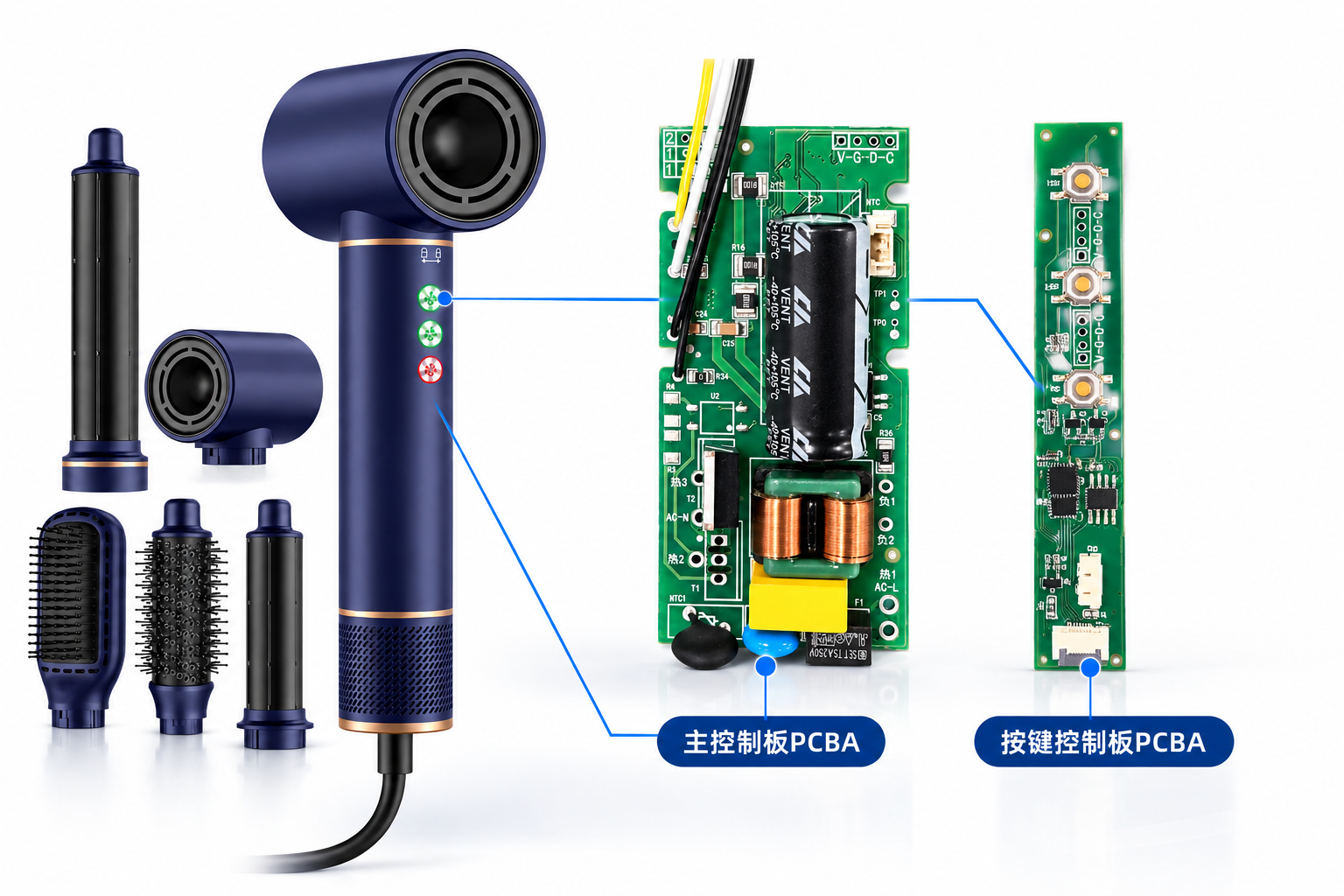
CHK-TRONIC’s technical capabilities include BLDC motor control, embedded firmware, power electronics, thermal protection and EMC engineering.
The starting point is a product specification that connects customer expectations with measurable engineering requirements.
For a high-speed hair dryer, this should define the selected motor, input supply, power, speed settings, heating modes and user controls. For a straightener or curling iron, it should describe heating behavior, temperature settings, sensing and interface functions.
Buyers should also identify the intended markets and where final assembly will take place. These details help establish the development scope and the responsibilities of each team.
Use Firmware Customization Within Validated Hardware Limits
Embedded firmware can support brand-specific operating behavior, such as button sequences, LED indications, default settings and mode transitions.
Documenting these functions early makes sample evaluation more efficient. The brand and engineering team can check the same agreed behavior rather than interpreting a general description differently.
Hardware changes require separate attention. A different input voltage, heater power or motor may affect component selection and validation. Such changes should be reviewed before they are treated as a software adjustment.
For brands planning several models, a variant list should identify the hardware revision, firmware version and operating requirements for each configuration.
Validate the Board in the Complete Appliance
A control board should be evaluated with the motor, heater, sensors, wiring and mechanical assembly intended for production.
For a hair dryer project, the agreed checks may cover start-up, speed transitions, heating modes and abnormal-condition responses. For heated styling tools, evaluation should address the specified temperature behavior and protection functions.
The exact test plan depends on the product design. Defining it before sample approval gives purchasing and engineering teams a common basis for deciding whether the solution is ready.
Keep Repeat Orders Consistent
Once a sample is approved, record the hardware revision, bill of materials, firmware version and production test requirements.
Proposed substitutions or functional changes should follow an agreed review process. This allows the brand, control board supplier and assembly team to understand what has changed and whether further evaluation is needed.
For customers managing overseas supply and local assembly, clear version control makes repeat orders easier to specify and production issues easier to investigate.
Discuss Your Hair Care Control Board Project with CHK-TRONIC
CHK-TRONIC provides control board engineering, embedded software, prototyping, PCBA manufacturing and production support for beauty appliances.
If you are developing a hair dryer, straightener or curling iron for Mexico or Türkiye, send us your:
- Target markets and final assembly location.
- Input voltage and frequency.
- Motor specifications and heater power.
- PCB dimensions and connection requirements.
- Operating modes, indicators and other functional requirements.
- Expected sample quantity and production volume.
These details provide a practical starting point for reviewing the control platform, customization scope and sample-validation plan.
Request a Control Board Engineering Review
Email: jack@chkcorp.cn